.

periferic 8 (2008)

Concept

Periferic 8 – Art as Gift
Biennial for Contemporary Art
Iasi, Romania
3-18 October 2008

Curated by Dora Hegyi (project leader of tranzit. hu/ Budapest, Hungary)
Assistant curator: Zsuzsa Laszlo (HU)

Organized by the Vector Association (Iasi/Romania)

Opening:
National Theatre "Vasile Alecsandri" Iasi

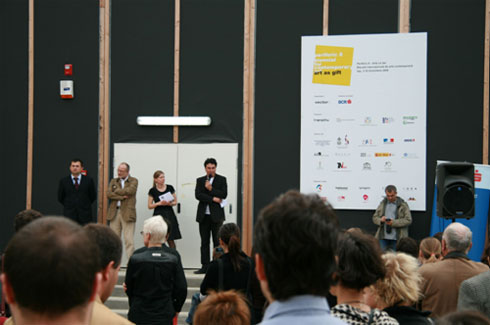
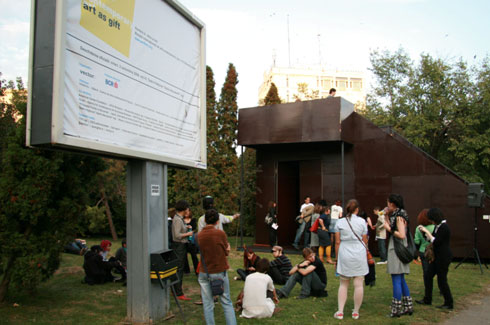
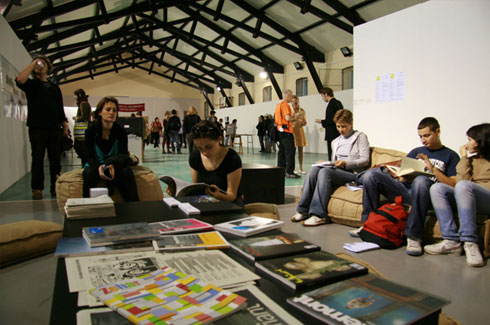
Opening of Periferic 8: The National Theatre of Iasi, 2.10.2008Markus Bader & raumlabor, Info Point for Periferic 8

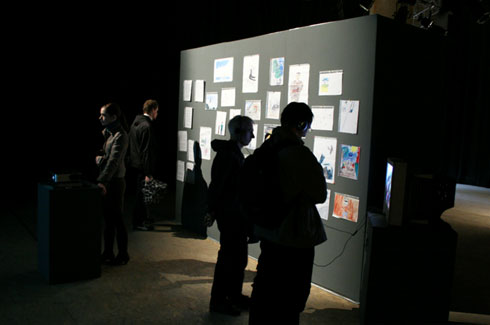
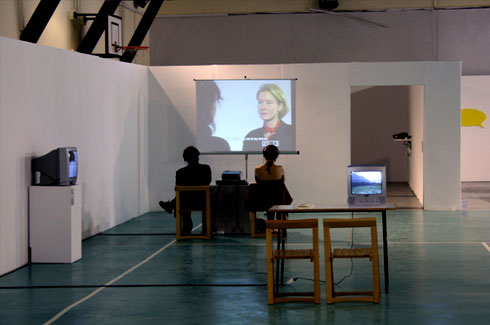
Guillaume Desanges - Children PlayPeriferic 8: view from the Sports Hall exhibition with works of Christian Jankowski and Daniel Knorr

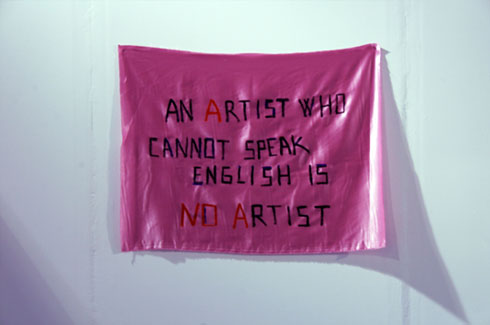
Periferic 8: Sports Hall ExhibitionMladen Stilinovic – An artist who cannot speak English is no artist

Periferic initiated in 1997 by the Romanian artist Matei Bejenaru started as a performance festival, which organically developed into an international art biennial organized in Iasi, the second university city in Romania.

Read more...

periferic 7 (2006)

Concept

Periferic 7 – Focussing Iasi
International Biennial for Contemporary Art
Iasi, Romania
May 12-30th, 2006

The seventh edition of Periferic Biennial is a project which focusses on different aspects of socio-political and cultural context of Iasi and Romania.

Periferic 7 focusses:
- on the position of Iasi in a globalized context where social, political and economical phenomena are influencing the cultural practices, productions and representations
- on the recent art history and the current art scene in Romania
- on the exploration of the children condition, emphasizing on the problem of 'child abandonment' in an extended sense.
Periferic 7 is structured on 3 independent sections curated by:
Marius Babias & Angelika Nollert, Florence Derieux and Attila Tordai-S.

Read more...

periferic 6 (2003)
Iasi, Romania
30 May – 14 June 2003

Iasi, Romania 
30 May – 14 June 2003

Concept

Prophetic Corners. Dealing With the Future
By Anders Kreuger (SE), curator of Periferic 6

That secret passion called future:
Which, in every great life, is counter-force
To other passions – counter-force and secret bedrock!

Vilhelm Ekelund (1880 – 1949): posthumous fragment

Dealing With the Future

Perhaps this cryptic Swedish poet was right. The future is inside us; it’s a driving force, and it feeds off the past. We use it as a tool for fashioning what matters most to us now: the present, our constant becoming. We have an almost instinctively pragmatic relation to our own personal future. We make plans, trying to predict things in our life and to evade the insight that some things will inevitably happen to us. Isn’t it strange, then, that the future is so often dealt with in cultural terms as something impersonal and imperial, something “futuristic” or “futurological”?

Western thinking has long been dominated by a linear understanding of time. In both grammar and philosophy, the future is traditionally seen as the weakest of the three basic tenses. The future tends to be associated not with “hard” knowledge (which we imagine to be verifiable in the present and past), but with the “soft” concept of utopia (a word that once meant “nowhere-land”). Since the future doesn’t yet exist, we have no facts about it, and we don’t know how to “deal” with it. In a culture that privileges information over intuition, the future remains a great unknown, a dream, a leftover.

Read more...

Periferic 5 Biennial
Iasi, Romania, May 2001

Periferic 5 Biennial

Iasi, Romania, May 2001

Concept

The “Periferic” project – a new beginning

Matei Bejenaru, curator Periferic 5

Looking back at almost five years from the first edition and trying to make an analysis as lucid as possible of the “Periferic” festival, I can declare that its rise and development in Iasi has, at least for those involved in its organization, a “therapeutic” value against provincialism. The “Periferic” project is utopian, as it wants to “reproduce” projects of the metropolis and to legitimate itself within the contemporary art’s global system of validation and hierarchic differentiation. At the same time, it is however realistic, as it galvanizes local artistic life connecting it to the open circuit of ideas and as it strives to achieve an independent artistic substructure meant to assure the communication with a public that needs to be formed and afterwards consistently informed.

Two categories of premises made possible the rise of the “Periferic” in Iasi. The first one is related to the local historic and cultural context, while the second has in view the situation of the Romanian visual arts in the first half of the ’90s. I will try to analyze each one separately, with the mention that the historical aspects appeal especially to the foreign readers.

Read more...