|
|
Gallery
Vector Gallery was functioning between December 2003 and October 2007 as a non-profit art space where were organized art exhibitions, debates, and workshops in the idea to interconnect the local art scene (Iasi and Romania) with other independent artistic and institutional initiatives from the regional and international context.
Events:
December 2003 – February 2006 | October 2006 – June 2007
Events: December 2003 – February 2006
1. Opening
[documentary installation + jazz concert]
December 2003
At the opening, Vector Gallery presented a video documentation of the Vector Association projects initiated between 2001 – 2003, focusing on the development of Periferic project. Jazz concert with Oana Severin (voice) and Alexandru Stehniov (bass).
2. Paula Miklosevic (Belgrade)
FETISH
[photo exhibition]
December 2003
The photos of Paula Miklosevic, which are reffering to the pornographic images, redefine the erotism and liberate the sexual obsessions from the threat of a normal functioning of society, becoming as a consequence a kitch version of consumism. Using the photos of some erotic dolls, the artificial body drives us to an imagination relating to whom the source of desire is just an impediment. Paula Miklosevic (1977) graduated from the "Braca Karic" Arts Academy. Paula Miklosevic graduated also from the Faculty of Philology, Department of General Literature. She is the editor in the Photo Gallery Circus of the Students Cultural Center (Belgrade) and writes for IMAGO, the international photo magazine (Bratislava).
3. Stefan Constantinescu (Stockholm)
DACIA 1300 – MY GENERATION
Curator: Tom Sandqvist(Stockholm)
[video project and book presentation]
April 2004
The video project Dacia 1300 - My Generation has its origins in the questions: Who am I? What was my childhood like during Ceausescu’s “golden era”? What is it like to live under a totalitarian regime? How are you influenced by terror and oppression? What paths does your life take when you can't trust those around you, your neighbors? When anyone could be an informant, a collaborator or snitch? When your life becomes more and more squalid, the electricity is cut off, food is rationed and the stores are empty and you, yourself, are forced to move to the outskirts of the city? What is it like to live under a totalitarian regime? How are you influenced by terror and oppression? What paths does your life take when you can't trust those around you, your neighbors? When anyone could be an informant, a collaborator or snitch? When your life becomes more and more squalid, the electricity is cut off, food is rationed and the stores are empty and you, yourself, are forced to move to the outskirts of the city?
The book that accompanies the project was co-authored by Ana Maria Zahariade and Tom Sandqvist. Ana Maria Zahariade deals with pseudo-architecture in Romania during Ceausescu’s times, while Tom Sandqvist describes both the political base as well as daily life during the communist regime.
The film is 62 minutes long and contains old archival footage, propaganda material and thirteen interviews, which were conducted with old neighbors from the bloc where the Constantinescu family lived, in the Colentina area of Bucharest.
The realization and presentation of the project was possible with the support of Konstnärsnämnden, IASPIS and the Sweden Ambassy from Bucharest. In Iasi, the presentation was supported bz Vector Association and French Cultural Center.
Stefan Constantinescu, born in 1968, finishes his studies at the Art Academy in Bucharest in 1996 and in 1993 comes to Sweden. Between 1994 and 1998 he studies at the Royal Academy of Art in Stockholm.
More info at: www.forma12.com/dacia
4. A tour of presentations by Davide Grassi (Slovenia), Neven Korda (Slovenia), and Alberto de Michelle (Holland)
April 2004
The program of presentations:
AKSIOMA, INTERMEDIA ART- Art & Technology, Art and politics, Art and Mass Media by Davide GRASSI
100% PURE VIDEO by Neven KORDA
AMSTERDAM ART CHANNEL PARK 4D TV by Alberto de MICHELLE
A co-production between: AoRTa Chisinau, Aksioma – Institute for Contemporary Art Ljubljana, and Vector Association Iasi.
Program supported by: the Ministry of Culture of the Republic of Slovenia and PARK 4D TV Amsterdam.
More info at: www.aksioma.org
www.internetportfolio.org/zanka
5. London Links. Discussions in Contemporary Art
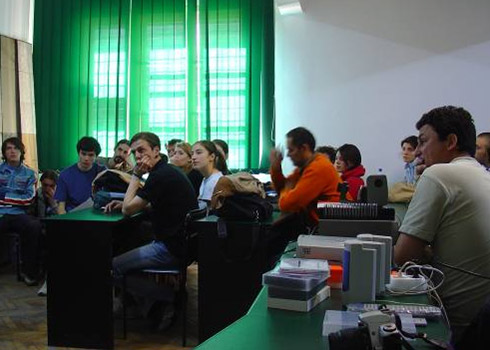
A series of presentations and conferences by Dr. Claire Bishop (professor at Royal College of Art, London) and Enrico David (professor at Slade School of Art London)
April 2004
6. Vlad Nanca and Stefan Tiron (Bucharest)
[presentation of ÎNCEPEM fanzines: CHIMIE and IEFTIN]
May 2004
“Începem” looks like a style magazine. It reads like a style magazine. Its contributors include some of the country's most talented artists, graphic designers, writers, photographers and all-round creative-types. It has a suitably hefty price-tag. And, for additional excitement in an era when consumers have a healthy disregard for all things mass-produced, it's ultra-limited edition. One copy will set you back a sweet 100 Euros. And only ten copies of each issue are ever produced. However, unlike the limited-edition high-fashion mags that can be found changing hands for large sums of money in New York and London, Începem is a fanzine. Though fanzines previously enjoyed a sporadic and underground existence, it was the punk movement of the late 1970's that became irreversibly associated with the art-form. At a time when the mainstream press had yet to wake up to the commercial opportunities that punk-rock presented, fanzines plugged the gap. Indeed, the low-budget, roughly photocopied scribbles of now-legendary fanzines such as Mark Perry's 'Sniffin' Glue' were the transferral of the punk ethic into print. Talent or professionalism weren't required. What counted was the democratising effect that the medium had. In a similar manner, anyone who wants to can contribute to Începem. Any kind of editorial role is reduced to ensuring that each contribution roughly fits the theme of the issue, that the offering is A4 in size and reproduced in ten copies. Contributions have come from as far afield as Holland, Spain, Austria and Serbia, ranging from professionally glossy photographs and pull-out sheets of stickers, to Xeroxed drawings and pages of painstakingly reproduced typewriter texts. The results are then bound to make ten fanzines.” Tom Wilson (freelance writer, lives and works in Bucharest)
More info at: www.2020.ro, www.incepem.blogspot.com
7. Bogdan Teodorescu (Iasi, RO)
THE SPEOSOPHY OF ART
[photo exhibition, installation]
June 2004
Conventionally, an art exhibition is perceived as a space of presentation for the art works or as an opportunity to meet the art's audience. Challenging this convention, Bogdan Teodorescu used the space of Vector> Gallery in Iasi also as a place for producing his photographic works, transforming it into a "working studio" in which he submitted to analysis and execution his own artistic experiences as well as his daily and historical reflections in relationship with the materials and people around him.
Bogdan Teodorescu lives and works in Iasi. Personal exhibitions: „Foto - Performance” (Cupola, 2002); „Le pouvoir est dans ma main” (Tinqueux Cultural Center– Reims, 2001). He exhibited also in the frame of Periferic 4 and 5, and in the frame of “Visual Eurobarometer” project (2005).
8. Anders Kreuger (Stockholm) and Maria Lind (Stockholm) [conferences]
June 2004
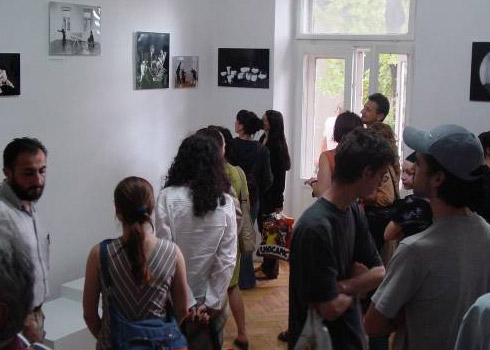
The Knowledge of No, a conference by Anders Kreuger (Stockholm) On Oda projesi's Actualisation of Space, a conference by Maria Lind (Stockholm) Anders Kreuger este an art critic and freelance curator from Stockholm. He was the first director of NIFCA Helsinki and curated the Periferic 6 Biennial in 2003. Maria Lind is a Swedish curator and art critic, ex-director of Munchener Kunstverein and presently the director of IASPIS. In 1998, she was co/curator of Manifesta 2.
9. Antje Schiffers (Berlin)
OUR FOREING CORRESPONDENT
[project and conference]
July 2004
As Correspondent and Ambassador of the Museum of Contemporary Art in Leipzig, Antje Schiffers travelled through Bulgaria and Macedonia, through White Russia, Estonia, Latvia and Lithuania, through Rumania and Moldavia.
Her assignment was to impart a picture of Germany in these countries and to impart a picture of these countries in Leipzig upon my return. She asked the colleagues from the gallery how they wanted to see Germany represented. Antje Schiffers followed to their instructions when she lectured in universities and beer gardens, in art institutions, and in living rooms during her travels.
Antje Schiffers put together a newspaper about each country. There were travel reports in the local media and on the web (www.korrespondentin.antjeschiffers.de). The collection put together based on the question "How do you want to see your country represented in Germany?“ is exhibited in the Museum of Contemporary Art in Leipzig, in the Hannover Kunstverein and the Goethe-Institute, New York.
10. Lucas Horvath (Vienna)
URBAN EVIDENCE_1 - ZLIN
[project presentation]
July 2004
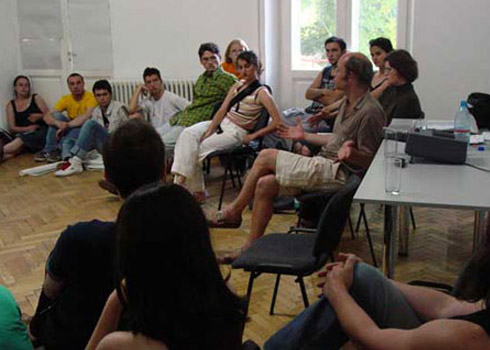
Lucas Horvath is working to an artistic project about Zlin city, an industrial center from Czech Republic. Its urban plan and architecture were conceived in the ‘20s – ‘30s in the time of Bata shoes company development. His artistic project analizes the way in which the ideas of progress and utopia found themselves in the functional aesthetics, the primitive forms of capitalism and globalization strategies. Lucas Horvath works in different media (photography, text, drawing, interventions in public spaces) and is interested in the relation established between the political system, the urban structures and the life of the inhabitants.
11. Florian Zeyfang (Berlin)
TRANSMISSION ATTEMPTS RELOCATED
[intervention + installation]
October 2004
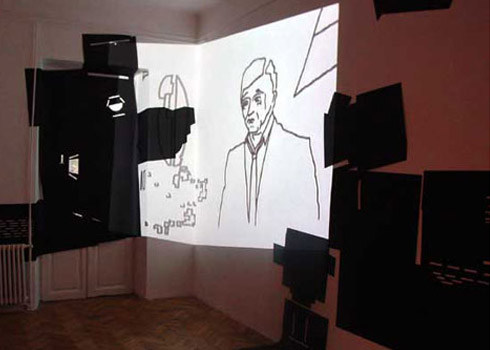
The short animation video "Transmission Attempts", literally over-drawing mediated examples on political uprising and the following (cultural) reactions, works with the tension between the political and aesthetic functions of film and video. In a new installation in Vector Gallery in Iasi/Romania, the video, originally conceived in New York, was placed in a relation to places where some of its sources originate. "The pathos of “Transmission Attempts” derives less from distance than from presence; it comes less from the insufficiency of critique, in the face of its totalizing object, than from a basic ambivalence regarding the ideologies that motivate critique in the first place" (Bennett Simpson, 2004). In Iasi, the mediated myth was linked back to one of its most recent mis-en-scènes.
12. Mona Vatamanu & Florin Tudor (Bucharest)
CONSUMING THE CITY
November – December, 2004
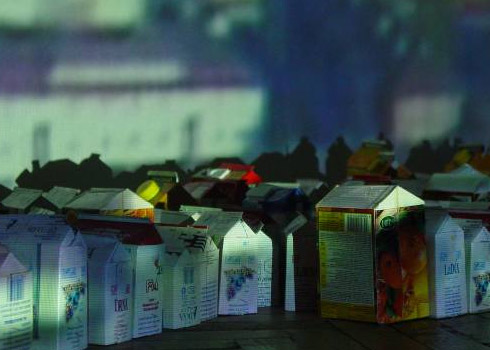
The films and video installations of Mona Vatamanu and Florin Tudor, analyze the relationship between nature and architecture from the perspective of urban ecology. The constant processing of the nature using architecture as interface is the result of the economical cycles based on production, consuming and recycling. The artistic projects propose a reflection of human condition in this context in which the natural opposes consumerism.
The artists have recent personal exhibitions at Ludwig Museum in Budapesta (project Room) in 2003, and at Buchsenhausen Labor in Innsbruck (Austria). In 2004 they participated in different group exhibitions: "Terrorvision" (Exit Art Gallery, New York), "Europa Jetzt" (Mak Nite, MAK, Viena), FILE (Sesi Gallery, Sao Paolo), “Cybersonica 03” (ICA, Londra).
More info at: http://www.exapes.org/
13. Timotei Nadasan, Vasile Ernu, Cosmin Costinas, Adrian T. Sîrbu (Cluj)
IDEA PROJECT [presentation of Idea art + society magazine + Idea design & print Publishing House + art center]
December 2004
More info at: www.idea.ro
14. Dragos Alexandrescu (Iasi, RO)
INDEX
[photo exhibition + video projection]
March 2005
In the photos and videos of Dragos Alexandrescu the present unfolds the distopic vision on the interiors’ comfort, the inhabiting intimacy, the reminiscences of the childhood utopy, the extensions of male sexuality, the abandonment of the space in negation. Using images of known public spaces and film sequences, the artist construct, through their digital manipulation, his own mythologies. Dragos Alexandrescu lives and works in Iasi. He exhibited in the frame of Periferic 4 and 5 project, and in 2004 he participated in the exhibition "The Way the World is..." from the Turkish Bath in Iasi.
15. STORYBOARDS. Trapped in the escape
an exhibition curated by Cosmin Costinas (Cluj, RO)
Artists: Andreas Fogarasi, Ciprian Muresan, Cristian Pogacean, Florin Tudor & Mona Vatamanu, VERSION
April 2005
The works in Storyboards are all parts of some narrations. In each of the works, the subject of the narration is seen in the moment when it realizes the role played in these scripts. The subject is different in each of the cases, be it a person or an entire nation, what all of them have in common is their incapacity to autonomize from their own history, from the fragmented and abusive storyboard of their own existence.
Storyboards was an exhibition on the tyranny of the story to the character, as a metaphor of the relationship between the subject and its identity constructions, between cultural predeterminations and individual attitude.
Our Playground (VERSION) is a mental game, equally accessible at an individual level and at the scale of a nation. It is a film about passive self-defense in front of history and the quotidian, a story about responses to traumas and attempts to ornament failure.
The Actors of Subliminal History (Cristian Pogacean) attempts to identify the mechanisms of power in the course of history, the actual actors of the great scripts and the relation between the individuals and the masses.
Trianon (Andreas Fogarasi) is a subtle adage on the anatomy of truth and the plurality of ways in which it can be constructed.
Leap into the void – after 3 seconds (Ciprian Muresan) speaks about the traumas of the individual to connect with his/her own destiny and with his/her cultural data.
Il mondo novo (Florin Tudor and Mona Vatamanu) reproduces a mysterious scene in a settecento painting by Giandomenico Tiepolo, a group of people stopped during a metaphorical walk, a journey at the dusk of an era.
16. Albert Braun (Vasa, Fi)
ME, MYSELF, NYKARLEBY, AND I [installation and reading]
May 2005
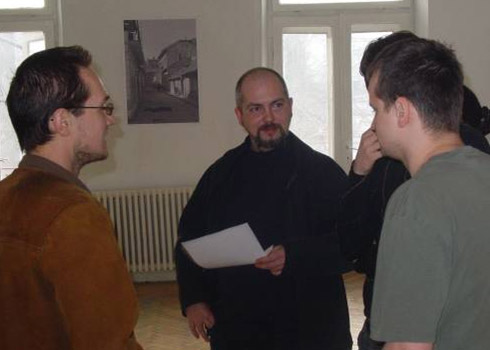
Me, Myself, Nykarleby and I contains different aspects for the viewer to come closer to the content. The basic idea, first and foremost, was to create a strong documentary, containing elements that are narrative, abstract, romantic, critical, humoristic, banal, etc. A certain “exoticness” could not be avoided, when something is presented abroad. But that was not the artists’ main goal. On the contrary, he worked against a romanticized and misunderstood homestead feeling, even though these elements were included in the project.
The exhibition can be compared to an open photographic album, where all the pictures are shown simultaneously. The simultaneity creates new interactive association opportunities between the photographs. The viewer decides the way, selection, and tempo through the photographic installation. Robert Åsbacka, a writer living in Sweden, supplemented the exhibition with similar observations and experiences on Nykarleby, but in a literary format. They were both raised in Nykarleby and still have connections to the area.
Albert Braun was born in 1958 born in Vilseck, Germany and studied at the Hochschule der Künste Berlin/W. 1978-1985. Since 1988 he is lecturer at the Swedish Polytechnic/Department for Fine Arts, Media and Design in Nykarleby, Finland.
Selected solo shows: Appointments: Blackboards & White Cube, Erfrischungsraum, Luzern (CH), 2001; Monument-Denkmal, Österbottens Museum, Vasa (FIN), 1998; Schwarz-Weiß, Galerie Hammer & Herzer, Weiden (D), 1995.
Selected group shows: SITUATED SELF - Confused, Compassionate and Conflictual, Museum for Contemporary Art, Belgrade, (SER-MO), City Art Museum Helsinki (FIN), 2005; ad lib. trans-art, Trondheim (N), 2001; The bible of networking, Sali Gia Gallery, London (GB), P-House Gallery, Ebisu, Tokyo(J), Art Foundation, Seoul, Korea, 1998.
17. INTER
a project by Robert Fearns (Bath, UK) and Matei Bejenaru (Iasi, RO)
May 2005
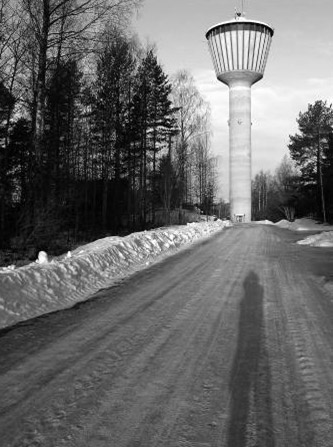
For the INTER project, Robert Fearns and Matei Bejenaru exchanged spoken translations of the street and buildings outside their respective galeries, R O O M in Bristol and Vector in Iasi, Romania, in the idea to construct imaginary images of the described streets. The work is as much to do with the social and conceptual process of interpretation and cultural exchange as it is with making and presenting pictures in a conventional sense.
18. Rosalinda Borcila (Tampa - Florida, USA)
EXCERPT
[exhibition & workshop]
June 2005
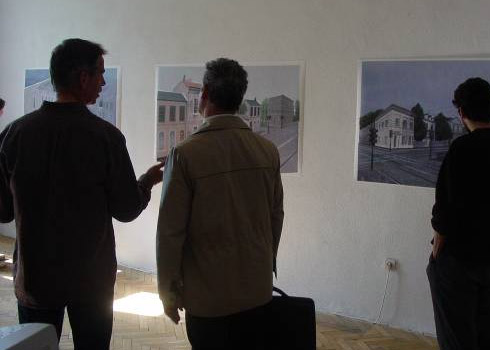
„common_places” brought 70 lbs of material to Vector Gallery in Iasi arranging left to right on the wall, the collectives with the longest duration to the left, the ones that are either the most recent or that have had the most brief existance on the right. this placed in immediate proximity dramatically different collective efforts — VideoFreex were next to RepoHistory and Umbruch BildArchiv, Kanak Attak was next to the Fluff Constructivists and Living Units. this also helped break down the division between collectives and resources on collectivity, ie between specific practice and materials that theorise collectivity at a more meta-level.
Rosalinda Borcila has organized a workshop at Vector Gallery on Intervention and performance’. More info at: www.borcila.tk, www.commonplacesproject.org
19. Dan Acostioaei (Iasi, RO)
FLUCHTPUNKTE (Vanishing Points)
[video installation]
June 2005
The video installation of Dan Acostioaiei examines the vanishing points of the political discourse and the social practices found in a relationship of visible contradiction. Through the visual analysis of ideology, doctrine, faith and habit, the artist deconspires the forced super(im)position of political intentions over the social realities. Any attempt of covering, hiding or ignoring the daily practices evidentiates, however, the structural gap between the political requirements and the social habits.
Dan Acostioaei lives and works in Iasi. He exhibited in Periferic biennial, Prague Biennial etc. More info at: http://www.dacosti.from.ro/
20. BORSEC project
[photography and video]
October, 2005
Participating artists: Andrea Schneemeier (HU), Farkas Rolland (SK), Rolf Pilarsky (D), Robert Fleischanderl (A), Marianne Engel (CH), Matei Bejenaru (RO), Miklósi Dénes (RO), Bartha József (RO), Irsai Zsolt (RO), Fekete Zsolt (RO), Sándor Sebesi (RO)
The exhibition presented a selection of photo and video art works produced in the artistic camp organized in Borsec (Romania) in August 2004 by ARTeast Foundation from Tg. Mures. The project was realized in collaboration with ARTeast Foundation from Tg. Mures and in parteneriat with the Municipality of Borsec. Sponsors: Romaqua Group SA, Communitas Foundation.
21. Christine Frisinghelli (Graz, A)
[presentation of Camera Austria magazine, Graz, Austria]
October, 2005
More info at: http://www.camera-austria.at/
22. Serial Cases_01: Acquaintance.
[video programme]
November – December 2005
Serial Cases is a a video programme and a collaboration project between ten curators from eight countries from the Balkan and Middle East which was screened during November and December 2005 at the initiative of Eyal Danon from Israeli Center for Digital Art in Holon who also coordinated the digital post production of the project.
The curators of the project are Michal Kolecek (Usti nad Labem, Czech Republic), Antonia Majaca (Zagreb, Croatia), Basak Senova (Istanbul, Turkey), Matei Bejenaru (Iasi, Romania), Margarethe Makovec and Anton Lederer (Graz, Austria), Galia Dimitrova (Sofia, Bulgaria), Eyal Danon (Holon, Israel), Orfeas Skutelis and Branka Curcic (Novi Sad, Serbia and Montenegro).
The video programme was simoultaneously screened in the Center for Contemporary Central European Art of the Faculty of Art and Design from Usti nad Labem (Czech Republic), the New Media Center_kuda.org, from Novi Sad (Serbia and Montenegro), The Red House - Centre for Culture and Debate from Sofia (Bulgaria), the Israeli Center for Digital Art from Holon, < rotor > at Forum Stadtpark from Graz (Austria), NOMAD at Istanbul Bilgi Univesity (Turkey), Galerija Miroslav Kraljevic from Zagreb (Croatia) and Vector > Gallery from Iasi (Romania).
More info at: http://www.nomad-tv.net/serial_cases
23. Minimal Diversions
an exhibition curated by Alina Serban (art critic and curator, Bucharest, RO)
Artists:
Anca Benera (RO), Erik Binder (SK), Gili Mocanu (RO), Ágnes Evelin Szabó (HU)
January 2006
The project "Minimal Diversions" shows different aspects of spontaneous diversions which can appear in the frame of artistic practice, as reactions to forms of authority. The cultural discourse of cultural relativism can play a role of a diversion by explaining the constant process of relocation of the therms in the cultural space. The exhibited works are dealing with different notions of movement: the exchange identity in the video of Ágnes Evelin Szabó, the surface in the installation of Gili Mocanu, or the personal geographies in the works of Anca Benera and Erik Binder.
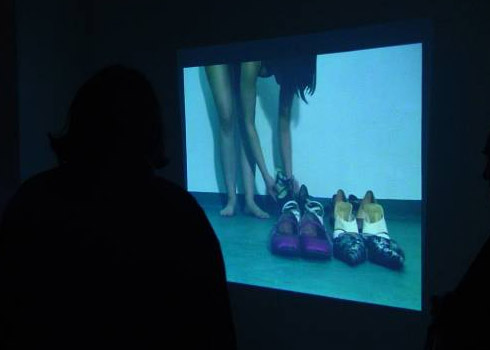
24. Panta Rhei
an exhibition curated by Ulric Roldanus (artist, Amsterdam, NL)
Artists: Hansjorg Voth (D), Kadir van Lohuizen (NL), Ulric Roldanus (NL), WAS Kunstverein (Eva Ursprung) (A)
February 2006
Hansjorg Voth (D) - "Reise ins Mehr" - documentary TV film of an action on Danube in 1978.
Kadir van Lohuizen (NL) - photojournalistic images of the Danube and Niger in Africa.
Ulric Roldanus (NL) - video film, installation.
WAS Kunstverein (Eva Ursprung) (A) - "The Danube Streaming Show", documentary video and a photo installation.
Off space events:
1. The Way the World Is
an exhibition curated by Stephanie Benzaquen (Tel Aviv) and Matei Bejenaru (Iasi) and organized by Vector Association of Iasi in collaboration with Centre Culturel Francais de Iasi
Turkish Bath of Iasi, October 22-24, 2004
Artists: Ligna Group (Germania), Rotem Balva (Israel), Adina Bar-On (Israel), Franck Houndégla (Franta), Clarice Hahn (Franta), Martin Zet (Republica Ceha), Charlie Citron (Olanda), Jeroen Jongeleen (Olanda), Aneta Mona-Chisa (Slovacia), Ciprian Muresan (Romania), Cezar Lazarescu (Romania), Muratbek Djumaliev & Gulnara Kasmalieva (Kyrgyzstan), Redas Dirzys (Lituania), Stefan Constantinescu (Suedia), Dragos Alexandrescu & Dan Acostioaei (Romania), Nita Mocanu (Romania), Dragos Platon (Romania)
The project "The Way the World Is" deals with the way the artist relates to reality: reality of his/her daily environment that should be translated and transmitted to the audience; reality where artistic practice and work display, which is sometimes unfamiliar when the artist comes to work, briefly, in a new place. Beyond the conditions and means of actualization themselves, there is the influence that this reality, temporarily, exerts on the artist: issues of the place and affects.
How to be impregnated with this reality? How to communicate the ephemeral impressions it lets? In other words, how to assume the superficiality linked to the discovery of the place and the short time that one can spend there? Is it possible to turn this superficiality into mediation tool? What can be done to generate interactions with the place and the audience, whatever the audience is? Last, can the artistic practice and the artwork reveal new facets of this reality to the people who experience it day by day?
2. Old Spaces – New Visions
[conference]
French Cultural Center Iasi and Goethe Zentrum Iasi
October 22-23, 2004
The conference was collecting ideas, experiences and solutions for transforming historical sites into contemporary art spaces. The reconstruction of the sites according to the new destination is a difficult process which could be influenced by different restrictions like the preservation of the architectural and objectual heritage, or the conditions imposed by owners.
How the contemporary art exhibitions, conferences or educational programmes could give a new symbolical dimension to the old site? What kind of strategies are the best to be chosen by the new contemporary art institution for achieving a professional level in cultural practice and, in the same time, to enhance the interest of a wider audience for this.
The conference focussed to the specific situation of the Turkish Bath of Iasi, which is planned to become in the future a Contemporary Art Space.
Participants:
Marius Babias (art critic and curator, Berlin) : "Display für Wissensproduktion
Kokerei Zollverein | Zeitgenössische Kunst und Kritik"
Liviana Dan (art critic, curator at Brukenthal Museum Sibiu, Romania): "Between the Frames / or a Dscret Charm of the Curator"
Attila Tordai (curator, director of Protokoll Studio Cluj, Romania): "Protokoll Studio"
Florence Derieux (curator, Paris) : "Palais de Tokyo"
Aneta Mona Chisa (artist, curator, Prague) : "The Memory of the Place"
(Presentation of the Synagogue - Centre of Contemporary Arts Trnava - Slovakia)
Mariana Fârtatescu (architect, Iasi) - "Inside the Spaces"
Catalin Gheorghe (art critic and theorist, Iasi) - "The Necessary Utopia: Maneuver Space for a Project"
Moderator: Matei Bejenaru
Presentation and launching of the book : "Subiectivitatea marfa. O povestire teoretica” by Marius Babias, Editura Idea Design & Print, 2004". Moderator: Catalin Gheorghe (art critic and theorist, Iasi)
3. Billboart Gallery Europe Project
coordinators: Juraj Carny, Mira Keratova (Bratislava, Slovakia)
December 2003 - October 2004More info at: www.billboart.org
4. Periferic 7 Biennial at Vector Gallery
Between October 2005 - February 2006, Vector Gallery hosted a series of conferences, presentations and workshops which took place at the initiative of Marius Babias and Angelika Nollert as curators in the frame of Periferic 7 Biennial – Focussing Iasi / Social Processes.
Also, in December 2005, with the support of French Cultural center, took place a series of artists presentations in the frame of Periferic 7 Biennial – Focussing Iasi / Strategies of Learning curated by Florence Derieux.
Periferic 7: Focussing Iasi / Social Processes
Curators: Marius Babias si Angelika Nollert
October 2005
- presentation of the projects of H.arta group (RO)
H.arta will exhibit and publish in the frame of Periferic 7 - Focussing Iasi / Social Processes.
November 2005
- drama workshop by Nicoleta Esinencu (MD)
January 2006
- conference held by Dan Perjovschi (RO)
My child draws like you
Dan Perjovschi presented his art projects based on drawings which are dealing with different political and social issues. Dan Perjovschi is one of the most important contemporary artists having a dense international agenda. He will exhibit and publish in the frame of Periferic 7 - Focussing Iasi / Social Processes.
- workshop and public presentation by Christine si Irene Hohenbuchler (A)
Christine si Irene Hohenbuchler will exhibit and publish in the frame of Periferic 7 - Focussing Iasi / Social Processes.
- presentation of the film „November” by Hito Steyerl (D) and conference by Boris Buden (A/D) on the theme „Remembering communism: between cultural memory and forgetting”
Hito Steyerl and Boris Buden will participate in Periferic 7 - Focussing Iasi / Social Processes.
- presentation of Laura Horelli (FI)
Laura Horelli will exhibit and publish in the frame of Periferic 7 - Focussing Iasi / Social Processes.
February 2006
- conference of Luchezar Boyadjiev (BG)
Billboard Heaven
(Notes on teh visual logic of the early neo-capitalism)
The lecture explores the urban visuality of cities as a reflection of the state of society. Based on comparison of examples from cities of mature capitalist societies, such as Paris and New York, as well as cities of developing neo-capitalist societies such as Sofia, Bucharest and Istanbul, I would argue that neo-capitalism is a new kind of societal development, which is producing specific urban space and visual environments/interfaces of cities as a function of the interplay/rivalry between the economical and political aspects in the life of an urban community.
The lecture is exploration into the visual logic of early neo-capitalism. Neo-capitalism is a kind of society that originated from the late totalitarian version of socialism that was to be found in the Eastern European countries of the former Soviet Block. Its “progress” is marked by processes of re-distribution of public wealth and “normalization” under the pressure of the looming membership into the European Union. Neo-capitalism is capitalism without bourgeoisie; consumer society without consumers (at least not yet…); and the development of its cities is marked by the stormy appropriation of public space by private interest.
All of these features are seen in the interface of Sofia, a city where you can put up anything, anytime, anywhere as long as you can pay…. In a neo-capitalist city the economical aspects in the life of the society are overpowering the political ones; the booming market is suppressing the civic agenda; the visuality of enterprising and consuming is eating up the visuality of reflection, contemplation or representation of anything else but consumer identity.
Luchezar Boyadjievwill exhibit and publish in the frame of Periferic 7 - Focussing Iasi / Social Processes.
- conferences by John Miller (USA)
The Vision of Modernity in the film “Playtime” by Jacques Tati
At noon
John Miller will exhibit and publish in the frame of Periferic 7 - Focussing Iasi / Social Processes.
Periferic 7: Focussing Iasi / Strategies of Learning
Curator: Florence Derieux
December 2005
French Cultural Center of Iasi
Public presentations of invited artists: Valentin Carron (Switzerland), Latifa Echakhch (Maroc), Pierre Joseph (France), Mattias Olofsson (Sweden). Vector Gallery Public presentation of Bik Van der Pol (Holland).
Valentin Carron, Latifa Echakhch, Pierre Joseph, Mattias Olofsson, Bik Van der Pol will display their works in the frame of Periferic 7 - Focussing Iasi / Strategies of Learning.
The projects of Vector Gallery from Iasi are supported by Swiss Culture Programme in Romania - PRO HELVETIA-SDC. |
|